Archives: DSE SEATING AT WORK
DSE SEATING AT WORK
Introduction
Most jobs nowadays require people to sit whilst working. This is partly due to the rapid increase in information technology and mechanisation within business and industry. Unsuitable seating can cause people to adopt awkward postures which can lead to discomfort, back pain and upper limb disorders. This may prove costly to employers in the form of staff absences, potential civil claims and lost production. Individuals also bear some of the costs in the form of suffering and lost income.
Assessing whether seating design is suitable and safe
When choosing or assessing seating design employers need to consider the needs of the individual, the type of work being carried out and the dimensions of the workstation. There are simple basic checks to ensure that seating is safe and suitable:
- Is the chair comfortable for the intended period of use?
- Is the lower back adequately supported?
- Is the upholstery sufficiently supportive and comfortable?
- Are edges sufficiently padded and shaped to prevent uncomfortable pressure on the thighs?
- Does the chair have adequate types and ranges of adjustment?
- Is the height adjustable to allow work to be carried out at or below elbow height?
- Does the backrest adjust sufficiently in height and depth to allow the user to gain support?
- Are armrests suitable for the task and workstation?
- Do the armrests allow the user to bring the chair far enough forward?
- Do the armrests allow adequate arm movement?
- Are footrests required and, if so, are they suitable?
- Are there special requirements for a chair at this particular workstation? Are there special user requirements?
- Are there special task requirements?
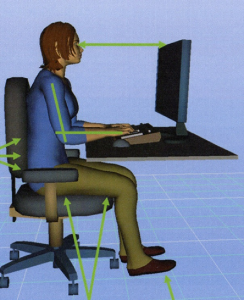
Action to be taken
Common sense steps that can be taken to encourage comfort, suitability and safety are listed as follows:
- Follow manufacturers’ and suppliers’ recommendations.
- Train individuals on how the seating should be adjusted to meet their needs and task requirements. Seek advice from safety representatives and consult with employees.
- Ask individuals if they have special seating needs and take action to improve comfort and safety.
- Ensure chairs are adjusted to suit the users, for example the seat height and/or backrest position should allow the user to comfortably and safely carry out their work.
- Ensure that the backrest is used to support the back and that the worker is not perched on the edge of the seat.
- Supply a footrest if workers’ feet cannot touch the ground.
- Provide seats with or without armrests, depending on which option is more comfortable for the worker.
- Encourage workers to take adequate rest breaks or rotate tasks if the seating or the workstation does not allow for movement.
- Change the seating design and/or workstation if, after a risk assessment, one or both are found to be unsuitable or unsafe.
- Maintain seating so that it is adequately clean, the upholstery is in good condition and the adjustment mechanisms work properly.
Individuals with special needs
The Workplace (Health, Safety and Welfare) Regulations 1992 require employers to take into account those employees with special needs. The aim should be to avoid employee discomfort and to promote well-being. For example, pregnant workers may require seating that can be adjusted without requiring awkward, bent postures. Workers with back problems or other mobility difficulties may have similar needs.
The Disability Discrimination Act 1995 places a duty on employers to make reasonable adjustments to the workplace or employment arrangements so that a disabled person is not at any substantial disadvantage compared with a non-disabled person. This might include considering appropriate seating provision for disabled employees where necessary.
GD Associates can carry out DSE Assessments for your entire workforce, contact us for further details.

